
The formulation
The full ingredient panel, dose by dose.
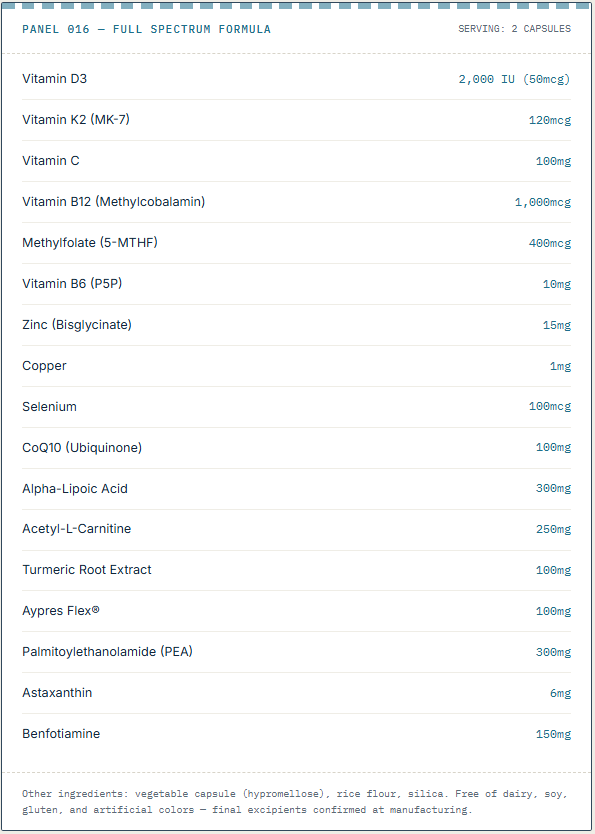
Seventeen actives, each dosed on its own line — no proprietary-blend hiding. These are the exact daily amounts in Panel 016, along with the evidence behind each one.
17
actives, 2 capsules daily
16
peer-reviewed sources cited
Updated
September 2026
Physician-developed. This formulation and its daily dosing were developed by Pain Science Solutions' founding physician for neuromuscular, cellular energy, immune, and inflammatory-response support.
By formulation category
What each active is doing, and how strong the evidence is
We rate the evidence behind each ingredient’s role in pain-relevant research on a simple scale, so you can see exactly how established — or how early — the science is. For the population-level rationale behind these categories, see The Science.
- Established — consistent RCT or meta-analysis support
- Growing — multiple positive trials, some heterogeneity
- Mixed — findings vary by study design or duration
- Preliminary — mechanistic rationale, limited direct trials
01
Bone, Muscle & Immune Support
Vitamin D3 (2,000 IU / 50mcg)
- Growing evidence
Deficiency has been found in a majority of patients across several chronic pain cohorts. Research links low vitamin D to central pain hypersensitivity specifically, though findings are more consistent for some pain phenotypes than others. Dosed within the clinical target range of 1,000–4,000 IU.
See The Science page, refs 1–5
Vitamin K2 (MK-7, 120mcg)
- Established role
K2’s job is downstream of D3: it activates proteins that direct calcium toward bone rather than soft tissue. Included as a functional pair with D3, within a clinical target range of 90–180mcg.
Mechanistic pairing with D3
02
Nervous System & Nerve Signaling
B12 (Methylcobalamin, 1,000mcg)
- Established mechanism
Directly involved in nerve function and homocysteine clearance. We use the pre-converted “active” methylcobalamin form because a meaningful share of people process standard synthetic B12 less efficiently.
Ref 1
Methylfolate (5-MTHF, 400mcg)
- Established mechanism
Supports methylation and neurologic health. Like B12, we use the active 5-MTHF form rather than synthetic folic acid, within a clinical target range of 400–800mcg.
Mechanistic, paired with B12/B6
Vitamin B6 (P5P, 10mg)
- Established mechanism
Supports neurotransmitter production. Dosed conservatively at the lower end of the 10–25mg clinical target range, since B6 has a narrower safety margin at high, sustained doses than most B-vitamins.
Mechanistic
Benfotiamine (150mg)
- Established (in DPN)
A fat-soluble B1 derivative with the most direct randomized-trial support of any B-vitamin here: a placebo-controlled trial in diabetic peripheral neuropathy (BENDIP) found measurable improvement in neuropathy symptom scores.
Ref 2
03
Antioxidant & Mitochondrial Support
CoQ10 (Ubiquinone, 100mg)
- Growing evidence
CoQ10 sits at the center of mitochondrial energy production. Fibromyalgia research has repeatedly documented lower CoQ10 levels and impaired mitochondrial function in affected patients; small placebo-controlled trials supplementing CoQ10 report reductions in pain and fatigue.
Refs 3, 4, 5
Alpha-Lipoic Acid (300mg)
- Mixed evidence
Earlier trials — especially with intravenous dosing — reported meaningful reductions in diabetic neuropathy symptom scores. A 2024 Cochrane review of longer oral trials, however, found little to no measurable effect on neuropathy symptoms at six months. We’re upfront that long-term oral evidence is genuinely mixed.
Refs 6, 7, 8
Acetyl-L-Carnitine (250mg)
- Preliminary
Shuttles fatty acids into mitochondria for energy production. Most supporting research studies it in combination with other mitochondrial nutrients rather than on its own — we treat it as part of a broader mitochondrial-support strategy.
Ref 5
Astaxanthin (6mg)
- Preliminary
One of the most potent naturally occurring antioxidants identified to date. Inclusion draws primarily on general antioxidant and exercise-recovery research rather than large chronic-pain-specific trials.
General antioxidant literature
Vitamin C (100mg)
- Established role
Antioxidant support and collagen synthesis. Dosed at the lower end of the 250–1,000mg clinical target range to complement the formula’s other antioxidants without excessive total load.
Established nutrition science
Zinc (Bisglycinate, 15mg), Copper (1mg), Selenium (100mcg)
- Established roles
Supports core antioxidant enzyme systems and normal immune and tissue-repair function. Zinc is paired deliberately with copper, since sustained high-dose zinc alone can drive down copper status over time.
Established nutrition science
04
Inflammatory Response & Joint Comfort
Turmeric Root Extract (Curcuminoids, 100mg)
- Established (in OA)
One of the better-studied natural compounds for osteoarthritis-related pain. Multiple meta-analyses of randomized, placebo-controlled trials — mostly in knee osteoarthritis — have found curcumin extracts measurably reduce pain scores and improve function versus placebo. Dosed conservatively relative to some trial doses (500–1,000mg); pairs with the formula’s other anti-inflammatory actives.
Refs 9, 10, 11, 12
Palmitoylethanolamide (PEA, 300mg)
- Growing evidence
A fatty compound the body already produces to help regulate inflammation and nerve signaling. Multiple systematic reviews and meta-analyses of double-blind trials — spanning neuropathic and musculoskeletal pain — have found PEA reduces pain intensity versus placebo, generally with good tolerability.
Refs 13, 14, 15, 16
Aypres Flex® Blend (100mg)
- Proprietary blend
A proprietary joint-comfort blend specific to Pain Science Solutions. Because the exact composition and supporting research sit with the ingredient supplier rather than public literature we can independently verify, we’d recommend pulling the formal research summary directly from that supplier before publishing specific claims here.
Pending supplier documentation
The complete label
Supplement Facts
Serving size: 2 capsules. All 17 actives, one panel.
Reading this evidence honestly
Nutrition research isn't a light switch.
- Most of the studies above measure a nutrient's role in specific, well-defined conditions (like diabetic neuropathy or knee osteoarthritis) — not chronic pain as one uniform category.
- "Established" doesn't mean guaranteed. Effect sizes vary study to study, and individual response depends on baseline nutrient status, diagnosis, and other factors.
- This formula is designed to close common nutritional gaps — it is not a clinical treatment protocol, and it hasn't been tested as a combined 17-ingredient formula in a clinical trial.
- None of this replaces bloodwork. A clinician checking your actual levels is the only way to know which of these gaps apply to you.
Selected references
Further reading
Primary sources for the ingredient-specific evidence cited above. For population-level chronic pain research, see the reference list on The Science page.
01
- From Nutrient to Nanocarrier: Vitamin B12 absorption & delivery — NCBI PMC
02
- Benfotiamine in Diabetic Polyneuropathy (BENDIP) randomized trial — ResearchGate
03
- Mitochondrial dysfunction & CoQ10 in post-viral fatigue syndrome — NCBI PMC
04
- Redox reactions in chronic pain: mechanisms & relevance in fibromyalgia — NCBI PMC
05
- CoQ10 + NADH supplementation in ME/CFS, RCT — NCBI PMC
06
- Alpha-lipoic acid in diabetic peripheral & cardiac autonomic neuropathy — PubMed
07
- Alpha-lipoic acid for diabetic peripheral neuropathy — Cochrane review, 2024 — Cochrane Library
08
- Alpha-Lipoic Acid in DPN: challenges of a 70-year-old compound — NCBI PMC
09
- Curcumin extract (Curcugen®) on knee osteoarthritis pain, RCT — MDPI Nutrients
10
- Curcumin & serum inflammatory biomarkers in knee OA — meta-analysis — BMC Complementary Medicine
11
- Efficacy & safety of curcumin in knee OA — Bayesian network meta-analysis — ScienceDirect
12
- Curcumin + boswellic acid vs. placebo in osteoarthritis, RCT — NCBI PMC
13
- PEA effects on nociceptive, musculoskeletal & neuropathic pain — meta-analysis — NCBI PMC
14
- PEA in the treatment of chronic pain — systematic review & meta-analysis — NCBI PMC
15
- PEA, a special food for medical purposes, in chronic pain — pooled meta-analysis — PubMed
16
- PEA in chronic pain of differing etiology, observational study (n=610) — PubMed